
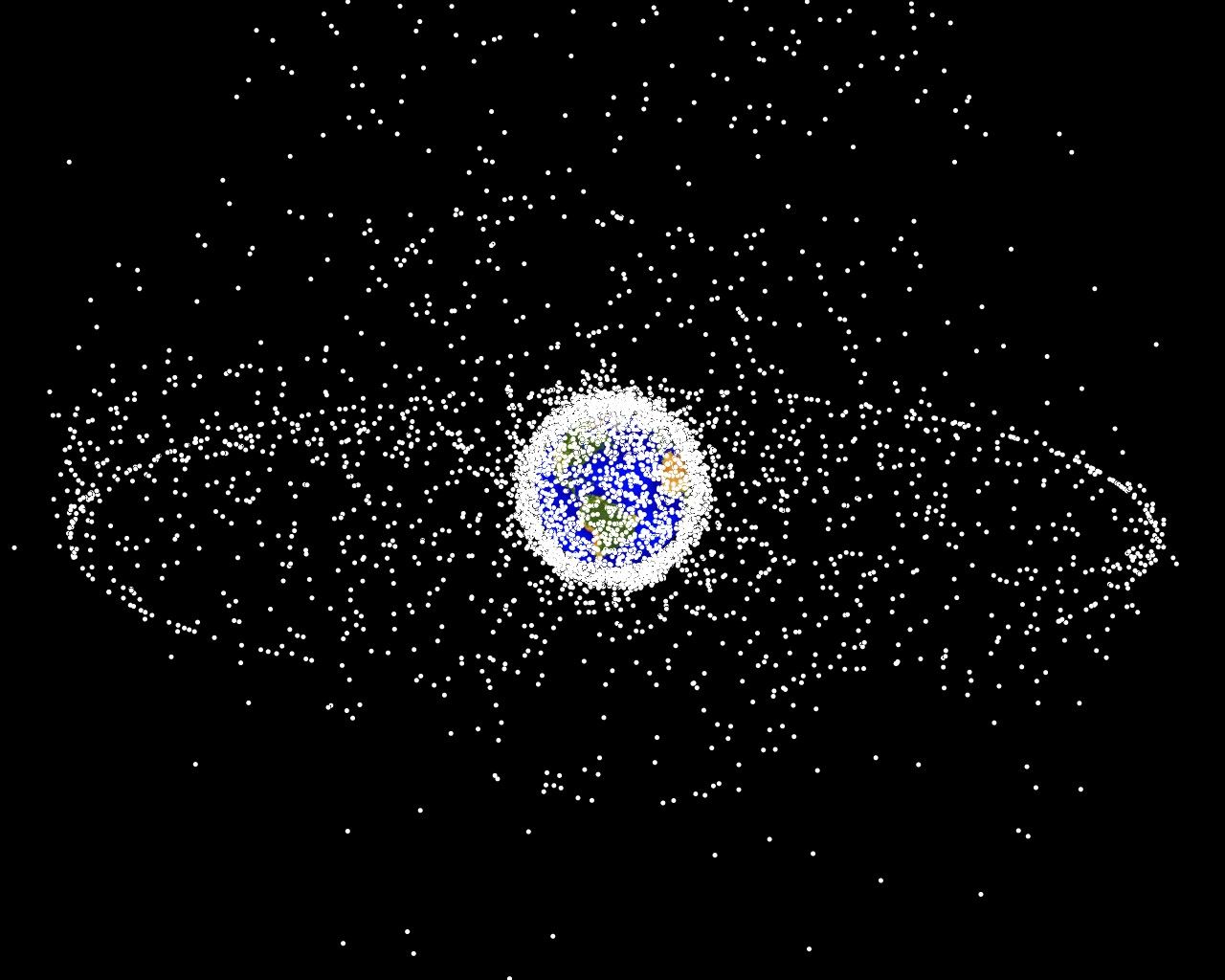
Most people have never heard of Kessler Syndrome. By the end of this post, you won’t be able to stop thinking about it.
The Scenario
In 1978, NASA scientist Donald Kessler and his colleague Burton Cour-Palais published a paper with a quiet but alarming prediction. They argued that as humanity put more objects into low Earth orbit, collisions between satellites and debris would eventually become self-sustaining — each collision creating fragments, each fragment becoming a projectile that causes the next collision, in a runaway cascade that could render entire orbital bands permanently unusable.
Not in a Hollywood 90-minutes timeframe. Over decades. Quietly. Irreversibly.
That scenario became known as Kessler Syndrome. And it’s no longer theoretical.
Where We Are Right Now
There are currently an estimated 600,000 pieces of debris between 1 and 10 centimeters in orbit, plus over 23,000 pieces larger than that. Wikipedia Nearly all of it travels at least eight times faster than a rifle bullet. SpaceX’s Starlink satellites alone had to maneuver around potential debris impacts over 144,000 times in just the first half of 2025 — a collision warning every couple of minutes, around the clock, for six straight months, at three times the rate of the previous six months. IEEE Spectrum
The International Space Station has been forced to perform avoidance maneuvers on multiple occasions, including two incidents within a single six-day period in November 2024, and again in April 2025. AMPLYFI
A 2025 paper co-authored by Kessler himself — now in his mid-80s — found that the current population of objects in orbit already exceeds the unstable threshold at every altitude between 400 and 1,000 kilometers. Dshr That’s the band where most satellites live. Where the ISS lives. Where your GPS, your weather data, and your internet connections are coordinated from above.
The scientific community hasn’t reached consensus on whether Kessler Syndrome has already begun. But there is consensus that the basic concept is sound and that the space community needs to clean up its act. Aerospace America The debate isn’t really if anymore. It’s when.
What It Would Actually Mean
A full Kessler Syndrome event could trigger widespread internet and WiFi outages and disrupt cellular, television, and GPS services — systems that roughly 68% of the global population depends on. Weather satellites that provide 85% of input data for forecasting models would be knocked out. There is no established cure — recovery would require massive investment and span years, possibly decades. AMPLYFI
We’re not talking about losing your signal for a day. We’re talking about a sustained, compounding collapse of the infrastructure that modern civilization quietly assumes will always be there.
Why We Built Aurora Sol Around It
When we started developing Aurora Sol, we wanted a premise that felt urgent — not manufactured urgency, but the kind that’s already sitting in a NASA report somewhere that most people will never read. Kessler Syndrome gave us that. It’s the inciting event of our game: you’re a space debris cleaner orbiting Earth when the cascade begins, and humanity’s connection to space is severed.
But we also wanted the game to do something. Not preach — show. Every destination in Aurora Sol is a real location in our solar system, built from actual NASA 3D assets and mission data. The same assets scientists and mission planners use. The game takes you outward — to moons and environments so strange they’d seem like fantasy if they weren’t documented fact — because we believe that when people understand how extraordinary and fragile our relationship with space actually is, they start to care about protecting it.
Kessler Syndrome is the reason space sweepers would exist. It’s the reason the job matters. And it’s the reason the journey to Saturn isn’t just a game — it’s a question the real space industry is already asking.
We’re at GDC this week in San Francisco. If you want to talk about Aurora Sol, the science behind it, or what it means to build a game around a real-world crisis, find us or reach out at company@aurastudios.online.
The orbit won’t clean itself.